
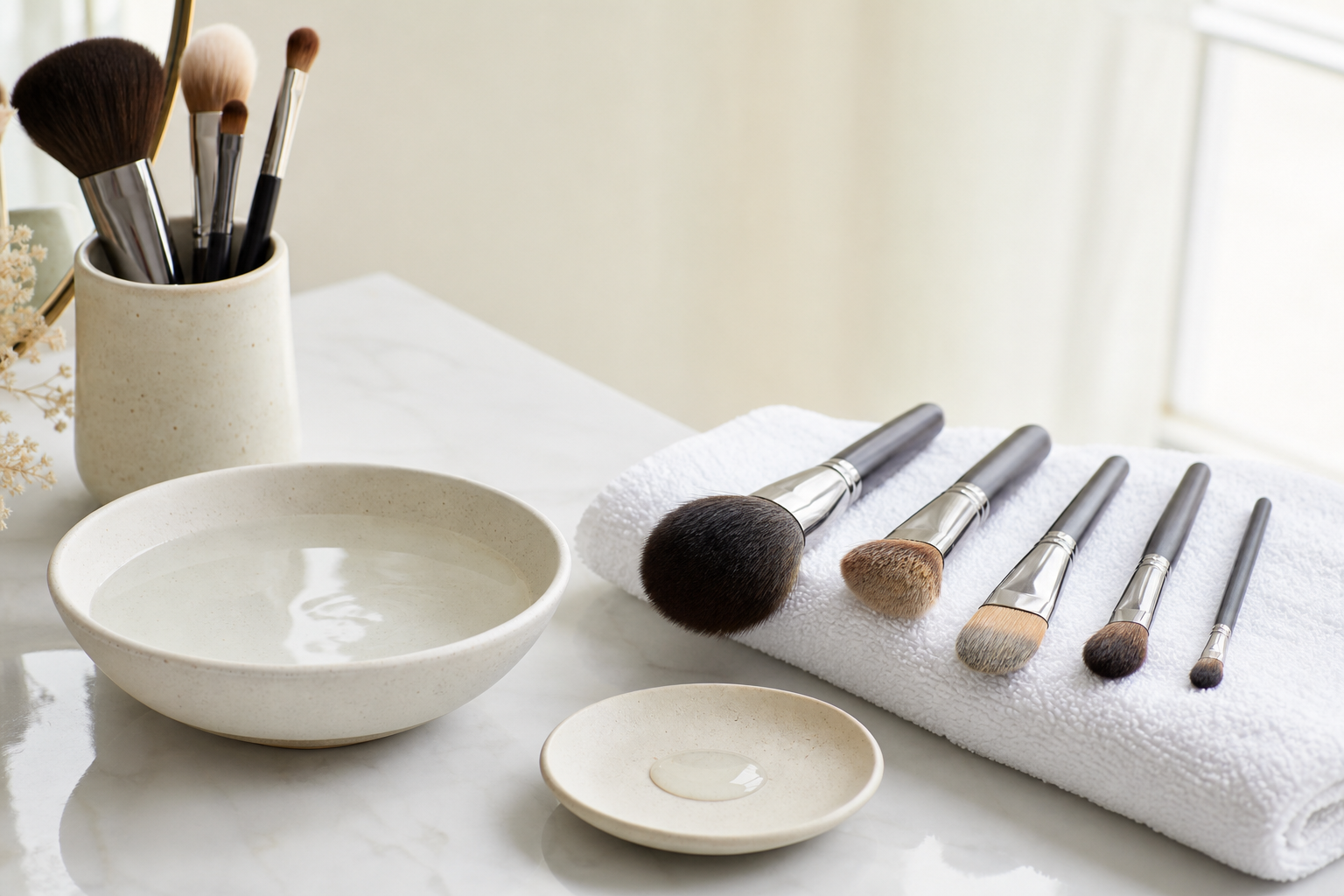
The short answer: most personal makeup routines need fewer brush shapes than large set counts suggest: a face brush, a complexion brush and two or three eye/detail brushes cover many everyday looks. Clean personal brushes on a regular schedule—the American Academy of Dermatology recommends every 7 to 10 days—rinse only the bristle tips, and dry them flat with the tips extending over a counter edge. Replace a brush when cleaning no longer restores it, the bristles shed or stay misshapen, the ferrule loosens, the handle cracks, or it develops persistent odour or residue.
This My Makeup Brushset guide explains brush roles and hygiene without assuming that any exact set is hypoallergenic or cruelty-free. Verify those claims, bristle material and included shapes on the current product listing before ordering.
Core makeup brush roles at a glance
| Brush shape | Typical role | What to look for | Cleaning focus |
|---|---|---|---|
| Large fluffy face brush | Loose or pressed powder; soft diffusion | Even bristle shape and a comfortable handle | Work cleanser through the dense centre, then rinse fully |
| Flat or rounded complexion brush | Liquid or cream foundation | Shape matches preferred stippling, sweeping or buffing technique | Remove product near the bristle base without soaking the ferrule |
| Angled face brush | Blush, bronzer or contour placement | Edge gives control without scratching | Rinse until colour and cleanser are gone |
| Flat eye brush | Placing shadow on the lid | Size fits the user's lid and intended precision | Keep eye-area tools clean and personal |
| Tapered blending brush | Softening eyeshadow edges | Bristles return to their original shape | Reshape gently before drying flat |
| Small angled or detail brush | Brows, liner or targeted work | Firm, even edge with no sharp strands | Clean promptly after cream or gel products |
How many makeup brushes do you actually need?
Choose by products and techniques, not by the largest number. Someone who mainly wears powder and mascara may use a large face brush plus one or two eye tools. A routine with liquid foundation, blush, contour and layered eye colour may benefit from separate complexion and eye shapes so colours and formulas do not mix unintentionally.
The Mini 4 Piece Bamboo Brush Set provides a compact travel comparison. The 12 Piece Brush Set expands the range, while the 24 Piece Pink Makeup Brush Set suits shoppers who want more specialized shapes. Check the exact “included brushes” information rather than assuming every 12- or 24-piece kit contains the same tools.
If you already own a complete set, add a single brush only to solve a specific gap. For example, compare the active Powder Brush and Foundation Makeup Brush by shape and intended product format. A name describes a common use, not the only possible technique or a guaranteed finish.
How often should you clean makeup brushes?
The AAD advises washing makeup brushes every 7 to 10 days. That is a clear starting schedule for personal tools, but clean sooner if a brush is visibly soiled, shared accidentally, dropped, used on irritated skin, or switching between products that should not mix. Professional artists and shared settings require separate hygiene protocols, disposable applicators and local rules beyond this personal-use guide.
The U.S. Food and Drug Administration advises washing hands before applying cosmetics, keeping containers clean, not sharing makeup and ensuring any instrument used near the eye is clean. Health Canada likewise advises consumers not to share makeup. Treat brushes as personal tools and do not dip a used brush into another person's product.
Seven steps to clean makeup brushes
- Wash your hands and clear a clean work area. Separate brushes by product type if that makes the process easier.
- Rinse only the bristle tips under lukewarm running water. Point the bristles downward and avoid submerging the whole head, which can affect the connection between bristles, ferrule and handle.
- Use a gentle cleanser. The AAD describes lukewarm water with gentle or clarifying shampoo. Follow any instructions supplied with the exact brush.
- Swirl and massage the tips gently. Work through visible residue without pulling, twisting aggressively or scraping the bristles.
- Rinse and repeat until the water runs clear and cleanser is removed. Keep water away from openings in the ferrule where practical.
- Remove excess water with a clean, dry paper towel or lint-free towel. Do not wring the brush.
- Reshape and dry flat on a clean towel with bristles extending over the counter edge so air can circulate.
Do not add saliva or water to cosmetic containers to re-wet dried product. FDA warns that this can introduce microorganisms and dilute preservatives. Cleaning a brush does not make an expired or contaminated cosmetic safe.
Why drying position matters
The AAD specifically cautions against drying brushes upright in a container because water can run down into the brush and loosen the glue connecting the head and handle. Drying flat with the bristles over an edge helps preserve the shape and allows airflow. Keep brushes away from a closed, damp bag until they are completely dry.
Avoid high heat from hair dryers, radiators or direct hot sunlight unless the manufacturer's instructions expressly permit it. Heat may affect bristles, adhesives, coatings or handles. Store clean, dry brushes where the bristles are not crushed and where dust is limited.
When should a makeup brush be replaced?
There is no single replacement date for every brush. Use condition-based signals:
- Bristles shed repeatedly, snap, feel scratchy or no longer return to their intended shape.
- The ferrule moves, separates or exposes edges.
- The handle cracks, splinters, peels badly or can no longer be cleaned.
- Persistent residue, staining or odour remains after correct cleaning and full drying.
- The brush was used during an eye infection or contaminated in a way that cannot be reliably cleaned according to its instructions.
- Application becomes uneven because the edge or density has changed significantly.
If a cosmetic causes irritation, stop using it. FDA advises avoiding eye cosmetics while an eye infection or surrounding inflammation is present and discarding eye cosmetics used during the infection. For ongoing irritation, rash or suspected infection, consult a qualified health professional rather than relying on a new brush to solve the problem.
Travel and storage hygiene
Carry only clean, fully dry tools. Use a case that prevents bristles from being crushed while separating brushes from loose cosmetics and dirty surfaces. A brush roll or ventilated case can organize shapes, but a closed container is not a drying rack. Clean the case itself on a suitable schedule.
For touch-ups away from home, wash or sanitize hands as appropriate before handling products. Do not pass brushes among travellers. Retail testers should be applied only with new single-use applicators, consistent with FDA guidance.
Frequently asked questions
Can I clean makeup brushes with dish soap?
Use the method recommended by the brush maker. The AAD recommends gentle or clarifying shampoo with lukewarm water; harsh products may affect bristles or handles.
Can brushes dry upright?
The AAD recommends against it because water may run into the handle connection. Dry brushes flat with the tips extending over a counter edge.
Should foundation and eye brushes be washed on the same schedule?
Every 7 to 10 days is the AAD's general personal-use guidance. Clean sooner when residue, contamination, sharing or product changes make it necessary.
Can one brush be used for several products?
Yes when the shape and technique work, but clean between formulas or colours that should not mix. Eye-area tools should remain clean and personal.
Are synthetic brushes automatically hypoallergenic or cruelty-free?
No. Those are separate claims that require listing-specific evidence. Verify the exact product details and do not infer them from appearance or a broad material label.
Bottom line
Build a brush collection around real tasks, then protect it with a repeatable hygiene routine. Wash personal brushes every 7 to 10 days as the AAD advises, keep the ferrule from soaking, dry flat, never share and replace tools when wear or contamination cannot be corrected. Clean technique matters more than owning the largest set.